
Stop Building Workflows. Start Building Systems That Think.
If your automation strategy depends on you being awake, you’ve already lost. The shift from babysitting workflows to building digital employees changes everything.
By Jonathan Reeve · · industry
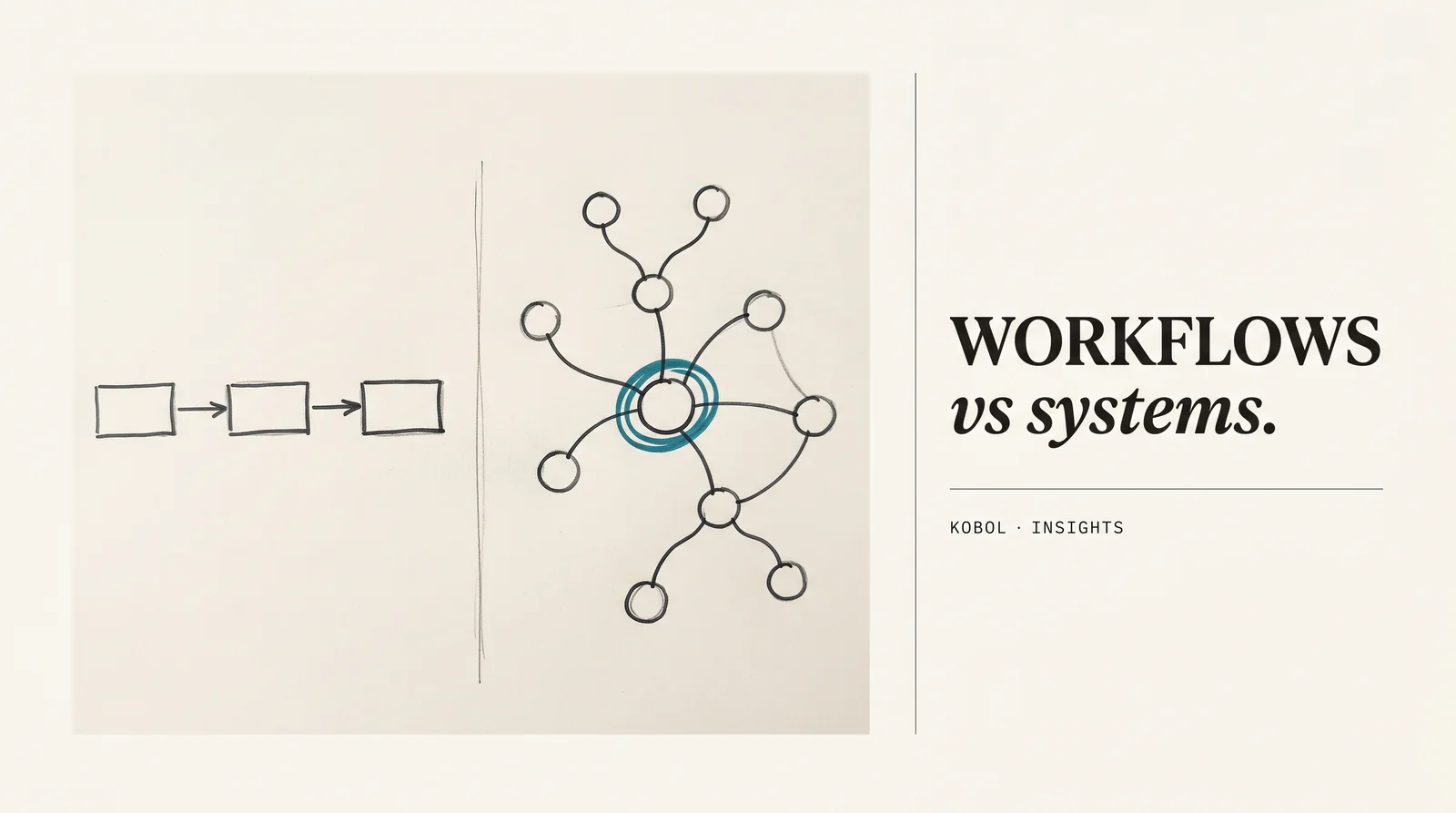
If your automation strategy depends on you being awake, you’ve already lost. That’s not a hot take. It’s a design principle. And it’s the difference between companies that automate tasks and companies that build systems capable of independent operation.
Most “automation” in 2024 and 2025 is glorified scripting. Trigger fires, steps execute, human checks the output. If something breaks at 3 AM, someone’s phone buzzes. If an edge case appears that wasn’t in the original workflow, everything stops until a person intervenes. That’s not automation. That’s a very expensive pager.
Workflows Execute. Systems Think.
There’s a fundamental difference between a workflow and an autonomous system, and most organizations conflate the two.
A workflow is a predefined sequence of steps. Input goes in, transformations happen, output comes out. It’s deterministic. It handles the cases you anticipated. It fails on everything else. Think: Zapier triggers, Make scenarios, basic n8n flows. Valuable? Absolutely. Sufficient? Increasingly, no.
An autonomous system is something different entirely. It observes, decides, and acts, without waiting for permission or a predefined path. It handles exceptions. It escalates intelligently. It operates on objectives, not instructions. When it encounters something unexpected, it reasons about the best course of action rather than throwing an error.
The gap between these two concepts is where most companies are stuck. They’ve automated the easy stuff, the data transfers, the notification triggers, the form-to-spreadsheet pipelines. But the high-value work, the stuff that actually requires judgment, is still bottlenecked on human availability.
The Technology Caught Up. The Strategy Didn’t.
Here’s what changed: Claude can now operate a computer. OpenAI is shipping multi-agent architectures. Google’s Gemini handles million-token contexts. These aren’t incremental improvements, they’re category shifts. The building blocks for genuine autonomy exist today.
Anthropic’s computer-use capability means an AI agent can navigate interfaces, fill forms, check dashboards, and execute multi-step processes across applications, the same way a human operator would, but at 3 AM on a Sunday without complaint. OpenAI’s agent frameworks let you compose specialized agents that collaborate on complex tasks, each handling their domain of expertise while coordinating toward a shared objective.
And platforms like n8n have evolved from simple workflow tools into legitimate orchestration layers. With the right AI development environment, teams can build, test, and iterate on agentic systems rapidly. You can build systems that run 24/7, monitor their own health, retry intelligently, and escalate only when genuine human judgment is needed, not just when they hit an unexpected data format.
The technology is ready. The question is whether your architecture is.
What “Autonomous” Actually Means in Business Context
Let’s be precise about what we’re talking about, because “autonomous AI” has become one of those phrases that means everything and nothing simultaneously.
In a business context, autonomy isn’t about AGI or sentient robots. It’s about systems that operate with bounded independence. They have clear objectives, defined guardrails, explicit escalation criteria, and the ability to handle variability within those bounds without human intervention.
Think of it like hiring. You don’t hire an analyst and then dictate every keystroke. You give them objectives, resources, guidelines, and authority within limits. Good employees handle 90% of situations independently and escalate the 10% that genuinely need a decision-maker. That’s exactly how autonomous business systems should work.
In real estate, where deal flow never sleeps, this distinction is existential. A workflow can send you an alert when a new listing matches your criteria. An autonomous system can evaluate the listing against your investment thesis, pull comparable sales data, draft a preliminary analysis, check zoning regulations, and surface a ready-to-review opportunity package, all before you’ve finished your morning coffee.
The Evolution: From Triggers to Agents
Understanding this evolution helps clarify where most organizations sit and where they need to go:
- Stage 1, Manual processes: Humans do everything. Spreadsheets, emails, copy-paste between systems. This is where most small businesses still live.
- Stage 2, Trigger-based automation: “When X happens, do Y.” Zapier, Make, basic n8n. Huge efficiency gain, but brittle. Any deviation from the happy path requires human intervention.
- Stage 3, Intelligent workflows: AI augments specific steps. An LLM classifies incoming requests, extracts data from documents, or generates draft responses. The workflow is still linear and predefined, but individual steps are smarter.
- Stage 4, Autonomous systems: Goal-oriented agents that plan, execute, monitor, and adapt. They handle exceptions, learn from outcomes, and operate continuously. Human oversight shifts from step-by-step supervision to strategic direction-setting.
Most companies have reached Stage 2 or early Stage 3. The winners in the next two years will be the ones that make the leap to Stage 4, not by abandoning their existing workflows, but by evolving them into something more capable.
Building Your First Autonomous System
You don’t get to Stage 4 by buying a product. You get there by rearchitecting how you think about automation. Here’s the practical framework:
Start with a process that’s high-value, high-frequency, and currently human-bottlenecked. Not your most complex process. Not your most sensitive one. Pick something where the cost of human involvement is obvious and the tolerance for autonomy is reasonable.
Map every decision point. Not just the steps, the decisions. Where does a human currently exercise judgment? What information do they use? What are the possible outcomes? How often do they encounter genuinely novel situations versus predictable variations?
Design the escalation boundaries. This is where most autonomous system designs fail. They either escalate everything (defeating the purpose) or nothing (creating risk). The art is in defining clear, measurable thresholds: confidence scores, financial limits, exception categories. When the system is 95% sure and the stakes are under $1,000, it proceeds. Otherwise, it escalates with full context.
Build the observation loop. Autonomous systems need to monitor their own performance. Not just “did the task complete” but “was the outcome correct” and “is the system degrading over time.” This feedback mechanism is what separates a robust autonomous system from a ticking time bomb.
This is exactly the methodology behind our agentic AI systems, building digital employees that don’t just execute tasks but own outcomes. The difference between deploying a workflow and deploying an agent is the difference between hiring a temp and hiring a full-time operator.
The Business Case Is Already Proven
This isn’t theoretical. Companies using agentic architectures are already seeing 60-80% reductions in human touchpoints for operational processes. They’re running lead qualification, document processing, vendor management, and customer onboarding with minimal human oversight. In healthcare, autonomous referral tracking systems are closing the loop between providers, not because they eliminated humans, but because they elevated humans to strategy while systems handle execution.
The question isn’t whether autonomous systems will replace workflows. They already are. At Kobol Automations, we help companies make this transition deliberately. The question is whether you’ll be the one building them or the one competing against them.
Stop babysitting workflows. Start building systems that think.
Ready to move from workflows to autonomous systems?
Book a free discovery call with Kobol. We’ll identify your highest-value automation opportunity and map the path to Stage 4.
Book a Free Consultation